

Cannabis edibles are gaining popularity in South Africa, but their sale remains tightly controlled. While private use of cannabis is legal, the Foodstuffs, Cosmetics and Disinfectants Act prohibits the commercial sale of food products containing cannabis or hemp derivatives. A 2025 amendment reinforced these restrictions, banning items like THC-infused gummies and hemp-based food ingredients unless approved by SAHPRA. Key concerns include public health risks, particularly for children, and unregulated products with inconsistent potency or contamination.
Although the ban affects businesses and consumers relying on cannabis wellness products, private use and SAHPRA-approved medicinal cannabis remain legal. Future regulations aim to balance public safety with the economic potential of the cannabis sector, focusing on THC limits, labelling standards, and stakeholder input.
Breaking down the ban on cannabis and hemp edibles in South Africa
sbb-itb-e2e45ce
What Is the Foodstuffs, Cosmetics and Disinfectants Act?
The Foodstuffs, Cosmetics and Disinfectants Act 54 of 1972 is South Africa's main law regulating food, cosmetics, and disinfectants. It officially came into effect on 1 January 1973 and has undergone several updates over the years, with key amendments in 1981, 1986, and 2007. This Act empowers the Department of Health to establish regulations that safeguard consumers from products that are unsafe, contaminated, or misleadingly labelled.
What the Act Covers
The Act oversees every stage of food production, from manufacturing and importing to retail sales. It ensures that food products meet safety, quality, and labelling standards. This includes regulating allowable ingredients and the accuracy of health claims.
Compliance is non-negotiable for all businesses in the food industry. The scope of the Act is extensive, addressing both the composition of food products and the way they are labelled for consumers.
How the Act Regulates Cannabis Products
The Act also applies to cannabis products. It draws clear lines between what is allowed and what is prohibited when it comes to cannabis. Under this law, the Department of Health bans the sale, manufacture, and importation of any foodstuff containing parts of the Cannabis sativa L plant, including hemp derivatives, even though private use of cannabis is legal in South Africa. However, consumers should still follow a cannabis edibles dosage guide for safety when consuming homemade products.
Authorities use the Act to monitor the market for restricted cannabis products. They are authorised to take action against individuals or businesses selling cannabis edibles and other unauthorised items. Enforcement covers the entire supply chain, ensuring that cannabis-infused products do not make it to commercial shelves without proper authorisation.
The 2025 Amendment: What Changed for Cannabis Edibles
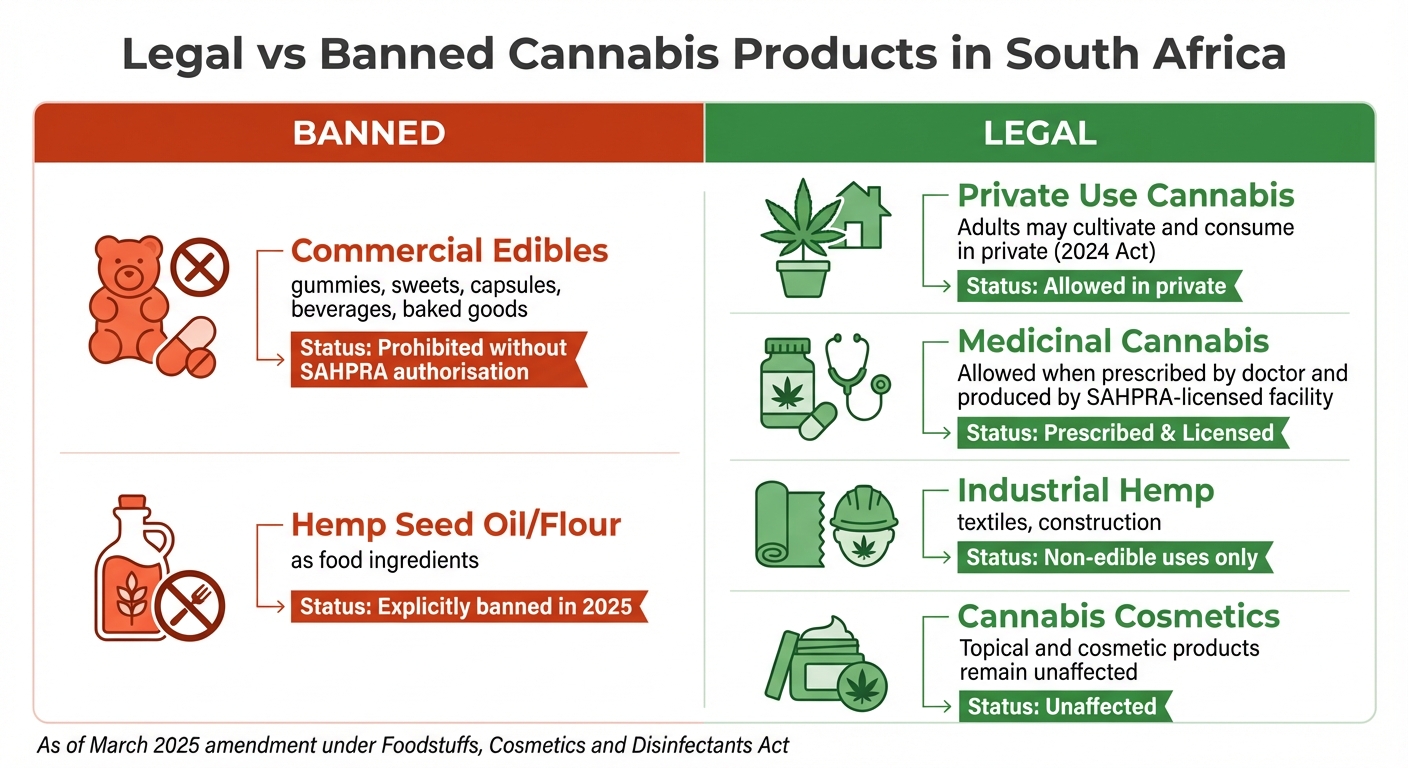
Legal vs Banned Cannabis Products in South Africa 2025
On 7 March 2025, the South African National Department of Health introduced a sweeping regulation under the Foodstuffs, Cosmetics and Disinfectants Act, which significantly reshaped the rules around cannabis edibles. The new regulation banned the sale, import, and manufacture of any food containing components of the Cannabis sativa L plant, effectively removing cannabis edibles from the market. However, following widespread opposition from businesses and other stakeholders, the government reversed the ban on 26 March 2025, allowing time for public consultation and further input. Even with this temporary reversal, the amendment made it clear that the government intends to impose stricter oversight on cannabis-containing food products, with the South African Health Products Regulatory Authority (SAHPRA) expected to play a central role. This move reflects the broader regulatory tightening already in progress.
The amendment laid out specific prohibitions, which are detailed below.
Banned Cannabis Edibles and Ingredients
The 2025 amendment targeted a range of cannabis-infused edible products. Items like THC-laced gummies, sweets, capsules, beverages, and baked goods were all included in the ban. Manufacturing, selling, or importing these products is now prohibited unless authorised by SAHPRA. Additionally, industrial hemp products such as hemp seed oil and hemp seed flour were explicitly barred from being used in food.
Foster Mohale, spokesperson for the Department of Health, explained the reasoning behind this strict approach:
"In the interest of public health safety of South Africans we want these products to be assessed by SAHPRA before being authorised for sale."
What Remains Legal
Although the amendment imposed restrictions on commercial edibles, it did not affect private use or doctor-prescribed medicinal cannabis. Industrial hemp used in non-food applications, such as for textiles or building materials, was also not impacted by the new rules.
Legal vs. Banned Cannabis Products
| Product Category | Legal Status | Details |
|---|---|---|
| Commercial Edibles (e.g., gummies, sweets, capsules, beverages, baked goods) | Banned | Prohibited under the Foodstuffs Act without SAHPRA authorisation. |
| Hemp Seed Oil/Flour (as food ingredients) | Banned | Explicitly included in the 2025 prohibition. |
| Private Use Cannabis | Legal | Adults may cultivate and consume cannabis in private under the 2024 Act. |
| Medicinal Cannabis | Legal | Allowed when prescribed by a doctor and produced by a SAHPRA-licensed facility. |
| Industrial Hemp (textiles, construction) | Legal | Ban applies only to foodstuffs, not non-edible uses. |
| Cannabis Cosmetics | Legal | Topical and cosmetic cannabis products remain unaffected by the prohibition. |
The amendment has sparked debate over its alignment with other cannabis-related laws. Connor Davis, Co-founder and COO of AKOS Bio, criticised the government's approach:
"The (notice) overreaches by effectively criminalising safe and legitimate sectors of the industry instead of providing a rational, risk-based framework."
This tension underscores the complexity of cannabis regulation in South Africa, where private use is legal but commercial cannabis edibles face heavy restrictions.
Why Cannabis Edibles Were Banned
The Department of Health’s decision to ban cannabis edibles was driven by serious concerns about public health and safety that had been growing since the 2018 decriminalisation of private cannabis use. With the market expanding unchecked, the government argued that this unregulated environment posed significant risks to consumers, particularly children and adolescents.
Health and Safety Concerns
The primary issue behind the ban was the lack of pre-market safety checks. Many products containing THC were sold with inconsistent potency levels, often exceeding safe limits. Adding to the problem, these edibles were designed to look like regular snacks, increasing the likelihood of accidental ingestion. Data from SACENDU revealed a troubling rise in cannabis-related hospital admissions among minors since decriminalisation. For children under 12, most exposures to THC edibles were accidental, leading to symptoms like lethargy, muscle weakness, a racing heartbeat, and difficulty concentrating.
Another pressing issue was the proliferation of unverified health claims. Barry Stuart, who monitors the industry, highlighted:
"the majority of 'medical' cannabis stores make unfounded claims about the benefits for everything from psychological conditions to cancer treatment"
These claims bypassed SAHPRA entirely, prompting the Health Minister to invoke Section 15(b) of the Foodstuffs, Cosmetics and Disinfectants Act. This allowed the government to skip the usual three-month public consultation period, citing the urgency of protecting public interest.
Testing and Regulatory Gaps
South Africa also lacked a national system for testing and monitoring cannabis edibles before the 2025 amendment. This regulatory gap raised serious concerns about contamination. Brenda Marx from Qure Laboratories explained:
"The biggest problem is microbials, that is due to handling and storage, moisture content in storage where there's good conditions for microbial growth, yeasts and molds, bacteria, things like that"
Unregulated products often contained heavy metals, pesticides, and harmful levels of microbial contamination due to poor manufacturing practices. Without a reliable testing framework, consumers faced risks from inaccurately labelled products. Many items falsely claimed specific THC dosages or government inspection. This stood in stark contrast to international standards, such as Canada’s 10mg THC limit per package or the 5mg per serving limits in some US states.
Penalties for Breaking the Rules
Violating the 2025 amendment that bans THC and hemp-derived edibles comes with severe consequences, including hefty fines and lengthy prison sentences. The penalties vary based on the nature and seriousness of the offence. Below is a closer look at the fines, jail terms, and how authorities enforce these regulations.
Fines and Jail Time
Under the Medicines Act, anyone caught unlawfully using or selling cannabis products could face up to 10 years in prison, along with applicable fines. Selling large amounts is categorised as drug trafficking under the Drugs and Drug Trafficking Act, carrying penalties that range from 12 months to 25 years in prison.
The CPPA imposes strict penalties for commercial violations, including fines and up to 15 years of imprisonment. For minor offences, the penalties are lighter but still significant, with fines and up to 6 years in prison. Individuals charged with minor possession may have the opportunity to expunge their criminal records under the CPPA. However, this option is not available for commercial offences.
How Authorities Enforce the Act
Enforcement of these penalties involves a coordinated effort by multiple agencies. The South African Police Service (SAPS), the South African Health Products Regulatory Authority (SAHPRA), and the Department of Health (DoH) work together to monitor the supply chain. This includes keeping a close eye on manufacturing facilities, retail outlets, and import channels for any signs of violations.
At airports, ACSA security personnel inspect travellers, focusing on those carrying cannabis products. If violations are detected, these agencies have the authority to take enforcement actions, such as initiating criminal prosecutions. Public consumption of edibles can result in charges for public intoxication or disorderly conduct. Additionally, transporting cannabis edibles across international borders is treated as international drug trafficking, which carries much harsher penalties compared to domestic offences.
Possible Future Changes to the Regulations
In March, President Cyril Ramaphosa withdrew the planned 2025 ban to allow for more stakeholder input and adjustments to the regulations. The updated rules, developed under the Foodstuffs, Cosmetics and Disinfectants Act, will now be shaped by expert advice and industry perspectives. This marks a move away from sweeping restrictions towards more targeted measures that balance public safety with economic opportunities.
"President Cyril Ramaphosa has affirmed his support for more stakeholder consultation and public participation on the formulation of new regulations that will limit health risk and the negative impact of foodstuffs containing cannabis and hemp, particularly on minors." – Vincent Magwenya, Spokesperson to the President
The Department of Trade, Industry and Competition (DTIC) plans to present a Hemp and Cannabis Commercialisation Policy by April 2026, followed by an Overarching Cannabis Bill by mid-2027. These developments aim to create a structured framework for the cannabis sector, which already reached a market value of ZAR470 million in 2024, despite operating under unclear regulations.
This ongoing review is expected to bring clarity to key areas like THC limits and labelling standards.
Proposed THC Limits for Food Products
As part of the regulatory overhaul, new THC thresholds for cannabis-infused foods are being considered. In November 2025, the Minister of Agriculture introduced a 2% THC cap for the leaves and flowering heads of cannabis plants classified as industrial hemp. For consumer edibles, the THC content must not exceed 0.001%, ensuring these products remain non-psychoactive.
Dr Andy Gray, a pharmaceutical sciences expert at the University of KwaZulu-Natal, pointed out that CBD products are already allowed as complementary medicines, provided they meet the 20mg per daily dose and 600mg per pack limits. Products exceeding these thresholds will require approval from the South African Health Products Regulatory Authority (SAHPRA). Foster Mohale, spokesperson for the Department of Health, explained:
"The Medicines Act allows for the sale of cannabis (in edibles) where the product makes a health claim or exceeds limits for active ingredients provided that the applicant is approved by SAHPRA".
Labelling Requirements and Consumer Information
One of the key areas under review is labelling. The Ministry of Health has raised concerns about unregulated imported foodstuffs containing hemp and cannabis entering the South African market. The new labelling rules aim to ensure transparency about cannabinoid content, potency, and potential health risks.
These updated standards will help consumers make informed decisions and reduce the risk of accidental ingestion. Cannabis businesses are advised to keep an eye on the Government Gazette for draft regulations and start preparing by implementing standardised testing protocols. Accurate reporting of THC and CBD levels on product packaging will likely become mandatory. This approach mirrors the stringent labelling requirements already in place for substances like alcoholic beverages.
How the Ban Affects Consumers and Businesses
The March 2025 amendment brought sweeping changes to South Africa's cannabis industry, creating a ripple effect that disrupted both consumers and businesses. Retailers were forced to pull all cannabis edibles from their shelves overnight, halting sales immediately. This sudden shift hit an industry valued at R28 billion, which had the potential to generate between 10,000 and 25,000 jobs across its value chain. For consumers, particularly those who depended on these products for wellness, the ban created a significant gap in access.
Impact on Access to Cannabis Wellness Products
The ban didn’t just target psychoactive edibles; it extended to products like hemp seed oil, hemp seed flour, and a range of nutritional supplements that were previously considered low-risk. Even non-psychoactive hemp products were swept up in the regulatory changes. For many users, this meant losing access to wellness products they had come to rely on. To continue using cannabis legally, some consumers were forced to register as patients and obtain prescriptions for approved products.
Economic Impact on Cannabis Businesses
The financial consequences for businesses were immediate and severe. For instance, Xpress Pineapple in Durban had to cut its staff from five to just one, warning that prolonged restrictions could lead to closure. Greenhouse 420, which operates three stores in Durban, reported that the ban jeopardised its total revenue and all existing jobs. Cannabis Life in Wynberg faced an immediate blow, having to clear its refrigerators and absorb the loss of daily revenue.
The effects didn’t stop at retailers. Manufacturers, hemp farmers, advertising agencies, and social media influencers connected to the cannabis supply chain also felt the impact. Ivan Meyer, Western Cape Agriculture MEC, summed up the broader implications, stating:
"The criminalisation of the sale of cannabis- and hemp-infused food products is not just a threat to jobs, it's a direct assault on economic growth and job creation."
Despite these setbacks, consumers are still finding ways to access legal cannabis products.
Finding Legal Cannabis Products
Although edibles remain off the shelves, other cannabis products such as flower, pre-rolls, and vaporizers are still available through trusted platforms. For example, Amazol offers quality-tested cannabis products in discreet, smell-proof packaging with delivery across South Africa. These items fall outside the "foodstuffs" category and remain legal for private use under the Cannabis for Private Purposes Act. For those seeking therapeutic benefits, medicinal cannabis licensed by SAHPRA is still accessible through registered pharmacies and healthcare practitioners.
Summary
Regulatory measures are actively shaping South Africa's cannabis industry, particularly in the context of food safety. The Foodstuffs, Cosmetics and Disinfectants Act 54 of 1972 oversees these regulations. Following the March 2025 amendment, food products containing any part of the Cannabis sativa L. plant, including hemp derivatives, are banned from commercial sale at all stages of the supply chain.
It's crucial for both consumers and businesses to understand these rules. For consumers, noncompliant cannabis edibles may be confiscated, while businesses face harsh penalties for unauthorised sales. The Act also enforces strict guidelines on labelling and advertising, ensuring transparency about ingredients and preventing misleading health claims. These regulations aim to tighten oversight on the testing and manufacturing of cannabis-infused food products.
Although edibles remain prohibited, products like cannabis flower, pre-rolls, and vaporisers are still legally available under the Cannabis for Private Purposes Act. Additionally, businesses are required to remove all Cannabis sativa L. components from food items before customs clearance. Keeping up with these evolving regulations is essential for everyone involved.
FAQs
Why aren’t cannabis edibles allowed under South African law?
Cannabis edibles are not allowed in South Africa under the Foodstuffs, Cosmetics and Disinfectants Act. This law strictly prohibits the sale, production, and import of food items containing cannabis or its derivatives.
The primary goal of this legislation is to prioritise public health and safety while ensuring that cannabis products are handled responsibly and remain within legal boundaries.
What are the consequences of selling cannabis edibles in South Africa?
Selling cannabis edibles in South Africa is against the law under the Foodstuffs, Cosmetics and Disinfectants Act. This legislation strictly prohibits the sale, production, and import of food products containing cannabis or hemp-derived ingredients. Breaking these rules can result in hefty fines or even criminal charges.
On top of that, the Cannabis for Private Purposes Act of 2024 makes it clear that selling THC or CBD products above certain limits is illegal unless specifically authorised for medical use or industrial hemp purposes. Understanding these laws is crucial to steer clear of any legal trouble.
What are the legal requirements for selling cannabis products in South Africa?
In South Africa, the sale of cannabis products is tightly regulated, with laws still taking shape. The Cannabis for Private Purposes Act allows adults to use, possess, and grow cannabis for personal use. However, the commercial sale of cannabis products, including edibles, remains strictly controlled.
The government is in the process of drafting new regulations to provide clearer guidelines for cannabis-related businesses. Until these are finalised, companies must adhere to current laws, such as the Foodstuffs, Cosmetics and Disinfectants Act, which oversees cannabis-infused food products. For businesses like Amazol, staying informed about these changes is crucial to ensure compliance.
At present, legally selling cannabis products in South Africa requires a thorough understanding of the existing rules and a readiness to adapt to future legal updates.
0 comments