

Breeding cannabis is about creating plants with specific traits through careful cross-pollination and genetic selection. Breeders aim to develop strains with desirable characteristics like pest resistance, high cannabinoid levels, or unique flavours. This involves choosing parent plants, controlled pollination, and stabilising genetics over multiple generations. Here's a quick breakdown:
- Parent Selection: Male and female plants are chosen based on traits like growth, resilience, and chemical profiles.
- Crossbreeding: Pollen from male plants fertilises female plants to produce seeds with combined genetics.
- Pheno-Hunting: Breeders grow and evaluate seedlings to identify the best-performing plants.
- Stabilisation: Backcrossing and multiple breeding cycles ensure consistent traits in future generations.
- Testing: Strains are tested in South African climates and labs for performance and quality.
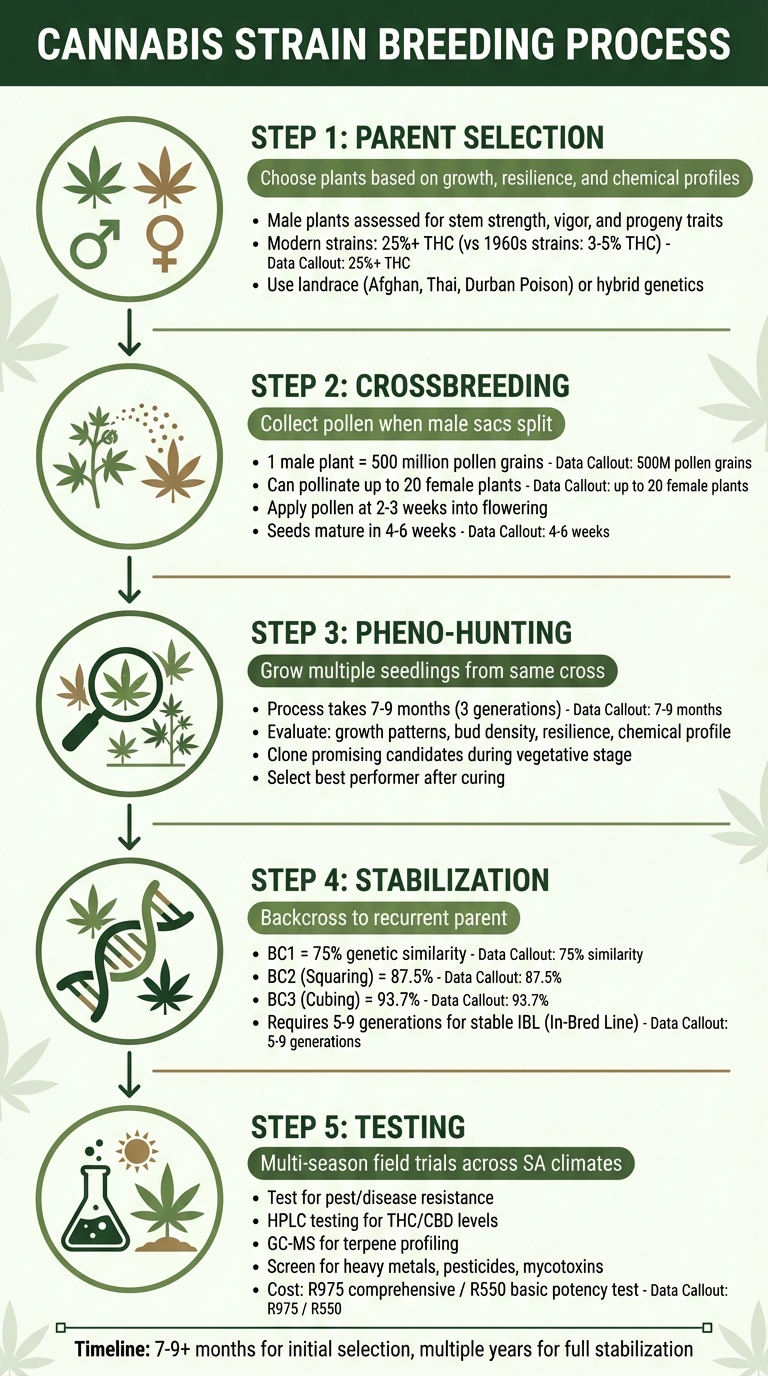
Cannabis Strain Breeding Process: 5 Steps from Parent Selection to Testing
Basic Guide To Create Your Own Cannabis Strain
sbb-itb-e2e45ce
Choosing Parent Plants for Breeding
Selecting the right parent plants is a cornerstone of successful cannabis strain development. Breeders focus on key traits like growth patterns, resilience, and bud quality to guide their choices. Jorge Cervantes, a well-known cultivation expert, highlights the importance of selecting male plants with care:
Choosing the proper male breeding stock is half of the equation. Choose the best males possible that show the desired traits.
The high-THC strains we see today, often exceeding 25%, are a direct result of deliberate parent selection. Compare this to cannabis from the 1960s, which typically contained just 3% to 5% THC. Male plants are carefully assessed for qualities like stem strength, vigour, and - through progeny testing - key traits such as potency and aroma. Keeping detailed records of each cross helps breeders track how traits are inherited.
This meticulous selection process lays the groundwork for precise crossbreeding techniques.
Landrace and Hybrid Genetics
Landrace strains are the original cannabis varieties that have evolved naturally over centuries. Cannabis journalist Luke Sumpter underscores their significance:
Landrace cannabis strains hail from humble origins but laid the genetic groundwork for all of the old-school classics and modern hybrids we enjoy growing and using today.
Take Durban Poison, for example. This landrace strain is prized for its resilience and distinctive flavour. Other notable landrace strains include Afghan, known for its hardiness and bushy structure; Thai, celebrated for its towering height and cerebral effects; and Acapulco Gold from Mexico, valued for its high yields and energetic effects. These strains contribute not only genetic diversity but also vital resistance to pests and harsh environmental conditions.
Hybrids, on the other hand, are created by blending specific traits from different parent plants. For instance, OG Kush combines genetics from Thai, Pakistani, and Indian landrace strains to achieve its renowned potency and aroma. Lowryder, the first commercially successful autoflowering strain, was developed by crossing Russian Ruderalis with Mexican Sativa. Breeders often cross two unrelated, stable lines to produce offspring with "hybrid vigour", a phenomenon where the resulting plants outperform both parents in growth, yield, and disease resistance.
Identifying Desired Traits
The genetic foundations provided by both landrace and hybrid strains guide breeders in deciding which traits to prioritise.
Parent plants are evaluated using traditional phenotyping methods, such as assessing bud density and flowering time, alongside modern DNA marker genotyping. Laboratory tests measure cannabinoid levels and terpene profiles in the resin produced by trichomes. Since male plants do not produce buds, their potential is determined by crossing them with known females and analysing the resulting offspring through progeny testing.
Advancements like high-throughput PACE Genotyping have made the selection process faster and more efficient. For breeders in South Africa, testing under local conditions - factoring in heat, drought, and pest challenges - is crucial to identifying genetics that can thrive in the country's diverse climates.
This rigorous evaluation naturally leads to the next phase in the breeding process: mastering effective crossbreeding techniques.
Crossbreeding Methods
To create new cannabis strains, breeders rely on controlled pollination to combine the genetics of selected parent plants. Thanks to cannabis' dioecious nature, this process allows for precise crossings.
The first step is identifying and separating male and female plants as soon as their sex becomes apparent. This prevents any unintended pollination. When male pollen sacs begin to split, breeders carefully collect the pollen using tools like foil, plastic cups, or parchment paper to catch it. A single healthy male plant can produce over 500 million pollen grains and is capable of pollinating up to 20 female plants.
Timing is everything. Female plants are ready for pollination when their stigmas become prominent, typically 2–3 weeks into the flowering stage. Breeders use small brushes to apply the collected pollen directly to specific female flowers, ensuring accurate delivery. To prevent accidental fertilisation, the grow area is usually sprayed lightly with water or a diluted bleach solution after pollination to neutralise any stray pollen.
Once pollinated, female plants need 4–6 weeks to develop mature seeds. These seeds, distinguished by their dark, mottled appearance, must be harvested, dried, and stratified before they are ready for germination and growth. Detailed records are kept throughout the process to track which crosses yield the desired mix of dominant and recessive traits.
This method of controlled pollination lays the groundwork for further refinement through selective breeding.
Selective Breeding
Selective breeding focuses on enhancing specific traits within a plant lineage by consistently choosing parent plants that exhibit the desired characteristics. The aim is to stabilise these traits, producing seeds that reliably grow into plants with consistent qualities. This process increases homozygosity, making it easier to predict how traits will be passed down.
One common technique is backcrossing, where an offspring is bred back with one of its parents to secure a particular trait.
Nat Pennington, founder and CEO of Humboldt Seed Company, explains the challenges breeders face:
To be a breeder, you have to be willing to accept the fact that you won't have uniformity in the offspring... expect to have to do a whole number of stabilising backcrosses to reproduce your golden goose in seed form.
Cloning plays a vital role in this process. By cloning successful parent plants, breeders can replicate exceptional genetic combinations indefinitely. Additionally, testing the germination rates of a small batch of seeds - such as planting 10 seeds - helps ensure seed quality before scaling up to larger grows.
Hybridisation
Hybridisation takes breeding a step further by combining two distinct genetic lines to create entirely new offspring. This process often involves crossing two unrelated, heavily inbred lines to produce an F1 hybrid. These first-generation hybrids frequently display "hybrid vigour" (heterosis), which can result in faster growth, higher yields, and greater resilience compared to their parent strains.
F1 hybrids are known for their uniformity and strength, making them a favourite among breeders. To maintain this reliability, breeders often preserve the original parent plants, allowing them to produce consistent F1 seeds repeatedly. However, the F2 generation - offspring of F1 hybrids - tends to show significant variability and may lose some of the vigour seen in the first generation.
Nat Pennington offers further insight into the role of parent plants in hybridisation:
Often in cannabis, the traits of the female carry over to progeny (seeds) more than the male. That said, the traits of the male are often obvious to the discerning grower so one should definitely choose a male that will complement the traits of the female.
Progeny testing is an essential step in this process, confirming whether the desired traits have been successfully passed on. Such techniques are especially important for developing cannabis strains suited to South Africa's varied climate.
Pheno-Hunting and Selection
Once controlled pollination is complete, the next step is pheno-hunting - an essential process for identifying the standout offspring. After crossbreeding produces seeds, breeders grow multiple seedlings from the same cross to pinpoint those that exhibit the most desirable traits.
While the genotype serves as the plant's genetic blueprint, the phenotype is its physical expression, shaped by environmental factors. This means that even genetically identical seeds can produce plants with varying traits, making it crucial to examine a large number of seedlings to find the best candidates.
Mark Smith aptly describes this process:
Pheno-hunting is an art that requires patience, knowledge, and a keen eye for detail.
For commercial breeders, this selection process usually spans three generations, taking anywhere from seven to nine months. Flowering cycles, depending on the strain, can last between six and 16 weeks.
Evaluating Phenotypic Traits
Breeders meticulously track each plant from seedling to cured flower, assigning unique identifiers to every candidate. Promising specimens are cloned during the vegetative stage to ensure their traits can be preserved if selected. After this, the original seedlings are moved into the flowering phase, where their full potential becomes clear.
During evaluation, breeders focus on several key traits:
- Growth patterns: Includes height, branching structure, and flowering speed.
- Flower characteristics: Such as bud density, colour, and trichome production.
- Resilience: Resistance to pests, mould, and temperature stress.
- Chemical profile: Terpene and cannabinoid content, which determine aroma, flavour, and potency.
Indica-dominant phenotypes are typically shorter, bushier, and produce dense buds, while Sativa-dominant types tend to grow taller with more spaced-out nodes and lighter, airier buds.
Stress testing plays a critical role in assessing resilience. Plants are subjected to challenging conditions, such as high humidity or fluctuating temperatures, to see which phenotypes can thrive in South Africa's varied climate. Any plant showing signs of mould, pest damage, or weak growth is eliminated.
The real test comes after the drying and curing process. This is when the plant’s aroma, flavour, and overall appeal are fully revealed - traits that cannot be judged accurately from the live plant alone.
This thorough evaluation process ensures that only the most promising candidates are chosen for stabilisation and further breeding.
Selecting the Best Plants
Once curing is complete, breeders compare all candidates to identify the top-performing plant. The winner is the one with the best combination of traits, and its corresponding clone - kept in a vegetative state during the process - is promoted to mother plant status. This mother plant becomes the foundation for producing identical cuttings for future grows or breeding projects.
Detailed records are critical to preserving winning genetics. Breeders carefully label and document every cross, noting which parent plants produced which offspring and how each performed under specific conditions.
To stabilise the desired traits, the selected phenotype may undergo backcrossing. This involves breeding the winning plant with one of its parents, ensuring that future generations inherit consistent characteristics rather than the unpredictable variation seen in earlier crosses. This step is key to producing seeds that reliably grow into plants with the desired traits, setting the stage for consistent and high-quality results.
Stabilising New Strains
Backcrossing for Stability
Once breeders identify the ideal phenotype, the next step is to refine and stabilise its traits. This is where backcrossing plays a critical role.
Backcrossing involves breeding a hybrid offspring back to one of its original parents, known as the recurrent parent. This method helps ensure that future seeds inherit and replicate the desired traits. With each backcross, the genetic makeup of the offspring becomes more aligned with the recurrent parent. For example:
- The first backcross (BC1) results in offspring that are 75% genetically similar to the recurrent parent.
- The second backcross (BC2) increases this to 87.5%.
- By the third backcross (BC3), the offspring reach approximately 93.7% genetic similarity.
Breeders often refer to the second backcross as "squaring" and the third as "cubing".
Jorge Cervantes, author of The Cannabis Encyclopedia, highlights the importance of this technique:
Backcross breeding is the most widely used form of breeding cannabis to date.
This process is particularly effective for locking in specific traits, such as a unique terpene profile or a consistent growth pattern. However, breeders must take precautions. Parent plants need to be stress-tested to ensure they don’t pass on undesirable traits like hermaphroditism. Additionally, seeds from each generation should be preserved as a safeguard against fixing unwanted characteristics.
Through this meticulous process, breeders can gradually enhance the genetic consistency of a strain, leading to more uniform performance across plants.
Achieving Consistent Results
Stability is key when it comes to creating reliable genetics. Sensi Seeds explains:
Stability refers to the variability and predictability found in the offspring of a parent generation: when a strain is unstable, variability will be high and predictability low; with a stable strain, the reverse is true.
For commercial growers in South Africa, having stable genetics is a game-changer. It ensures uniform harvest times, predictable yields, and a dependable experience for consumers. Achieving this level of consistency typically requires five to nine generations of selective breeding to create a fully stable In-Bred Line (IBL). The result? Seeds that produce nearly identical plants with every grow.
| Generation | Genetic Contribution |
|---|---|
| F1 Hybrid | 50% |
| BC1 | 75% |
| BC2 (Squaring) | 87.5% |
| BC3 (Cubing) | 93.7% |
Maintaining detailed records throughout the breeding process is essential. These records help breeders track which crosses led to specific results, ensuring consistency and reliability in stabilising new strains.
Testing Strains in South African Conditions
Climate and Pest Resistance
When a strain shows potential in controlled settings, the next step is to see how it performs in real-world South African conditions. This involves multi-season trials, testing the strain's adaptability across the country’s diverse climates - from the humid Eastern Cape to the arid Northern Cape. These trials help breeders understand how new genetics respond to local environmental pressures.
Between 2024 and 2025, greenhouse trials were conducted by DADI in Stutterheim (Eastern Cape) to compare propagation methods. Led by Azile Dumani and Tembakazi Theodora Silwana, the team discovered some key differences. Plants grown from seeds (sexual propagation) were taller and more vigorous, while those grown from cuttings (asexual propagation) reached physiological maturity faster and produced more female flowers under local conditions. These findings are crucial for identifying strains that thrive in South Africa.
Breeders also focus on a plant’s “hardiness,” or its ability to resist mould, root issues, and extreme temperatures. They monitor for pests and diseases specific to different regions, such as soil-borne pathogens and insect infestations. Many breeders begin with in-vitro tissue culture, ensuring disease-free starter material before moving to field trials. By keeping detailed records, they identify phenotypes that can handle South Africa's unique challenges.
Once a strain demonstrates resilience in these varying climates, it moves on to lab testing to confirm its chemical composition.
Cannabinoid and Terpene Testing
In addition to environmental trials, laboratory testing ensures that strains meet specific cannabinoid and terpene targets.
In South Africa, High-Performance Liquid Chromatography (HPLC) is the go-to method for accurately measuring THC and CBD levels. This technique is particularly valued because it preserves THCA and CBDA, as it doesn’t involve heat.
For terpene profiling, breeders use Gas Chromatography-Mass Spectrometry (GC-MS), which captures each strain’s distinct aroma and flavour. While some breeders use portable NIR spectroscopy devices for quick, on-site testing, these tools have a 10% error margin. They’re useful for early-stage evaluations, but final testing is always done in SAHPRA-licensed laboratories.
Dr Guy Setton, CEO and Cofounder of GemmaCert, emphasises the importance of rigorous testing:
The industry winners will be those who will invest in Quality Control to ensure that products are consistent, safe, effective and predictable.
Beyond the basics of THC and CBD, modern lab testing now includes minor cannabinoids like CBC, CBG, CBN, THCV, and CBDV. Labs also screen for heavy metals, pesticides, and mycotoxins to ensure the product is safe for consumers. For breeders aiming to comply with the legal hemp definition (under 2% THC as of November 2025), HPLC testing is indispensable.
Cost-wise, comprehensive lab testing is around R975 per sample, while basic potency tests cost approximately R550.
Conclusion
Breeding cannabis strains is a meticulous process that hinges on selecting the right parent plants, performing controlled cross-pollination, conducting detailed pheno-hunting, and stabilising genetics over several generations. Breeders focus on traits like high cannabinoid levels, pest resistance, or distinctive terpene profiles. Once the parent plants are chosen, they are cross-pollinated, and the resulting offspring are carefully evaluated to identify the most promising phenotypes. These selected traits are then stabilised through multiple breeding cycles to ensure consistency.
Once stabilised, these strains are put to the test in South Africa's challenging conditions. Through multi-season field trials and precise lab testing, breeders ensure the plants can withstand pests, harsh climates, and diseases while maintaining quality. The result is cannabis strains that meet rigorous breeder standards and are well-suited to local growing environments.
At Amazol, you’ll discover a curated selection of cannabis products developed by breeders who prioritise genetic consistency, quality, and transparency. Whether you're searching for high-THC strains or specific terpene profiles, Amazol offers a range designed to thrive under South African conditions.
FAQs
How do cannabis breeders create stable and reliable strains?
Breeders develop dependable cannabis strains through precise genetic selection and multi-generational breeding. A stable strain means plants will consistently display desired traits - like potency, flavour, or yield - with minimal variation.
This process involves selecting parent plants with specific characteristics and crossbreeding them across several generations, often from F1 to F7, to lock in those traits. By carefully isolating male and female plants, breeders can avoid unwanted pollination and maintain full control over the genetic lineage. The result? Strains that are consistent, reliable, and meet the expectations of growers and consumers alike.
By prioritising quality, breeders take the necessary time to perfect each strain, ensuring it thrives in different growing conditions. This attention to detail guarantees that every harvest delivers the same high-quality results, whether it's for personal enjoyment or commercial production.
What is the importance of landrace strains in developing new cannabis varieties?
Landrace strains form the backbone of modern cannabis breeding. These are pure, naturally occurring varieties that have developed over thousands of years in specific regions, entirely untouched by human intervention. They bring to the table a genetically stable foundation, offering unique characteristics like resilience, distinct cannabinoid profiles, and rare, one-of-a-kind flavours.
When breeders cross landrace strains with other cannabis varieties, they can craft new hybrids suited to different climates, purposes, and consumer tastes. This approach not only sparks creativity in breeding but also plays a vital role in maintaining the genetic diversity and authenticity of traditional cannabis strains. Landraces are key to the ongoing growth and variety within cannabis genetics.
What is pheno-hunting, and why is it important for creating new cannabis strains?
Pheno-hunting is a technique breeders use to pinpoint cannabis plants with the most appealing traits - think aroma, potency, flavour, or growth habits. The process involves growing several plants from the same genetic line and closely observing how their characteristics come to life.
This approach plays a key role in crafting new cannabis strains. It ensures that only the top-performing plants are chosen for further breeding. By focusing on plants with distinct and desirable qualities, breeders can develop exceptional strains tailored to specific tastes or needs.
0 comments