

When deciding between indoor and greenhouse cannabis cultivation, the choice depends on your goals, budget, and South Africa's unique climate. Here's a quick breakdown:
- Indoor Cultivation: Offers full control over temperature, humidity, lighting, and airflow, leading to consistent, high-quality cannabis with higher THC levels. However, it comes with high electricity costs, expensive setups, and challenges like load-shedding.
- Greenhouse Cultivation: Uses natural sunlight, lowering energy costs while still providing some protection against weather and pests. It’s more affordable to set up but less precise due to weather fluctuations and higher pest risks.
Key Factors to Consider:
- Costs: Indoor setups cost R800–R1,500/m² while greenhouses range from R200–R600/m². Monthly electricity for indoor growing can exceed R25,000, compared to R5,000–R12,000 for greenhouses.
- Energy Use: Indoor systems heavily rely on artificial lighting and HVAC, while greenhouses utilise sunlight, cutting electricity use by up to 90%.
- Yield & Quality: Indoor offers consistent, dense buds with higher THC. Greenhouses produce larger plants with rich terpene profiles thanks to natural light.
- Local Climate: South Africa's sunny conditions favour greenhouses, but extreme weather may require additional climate control.
Quick Comparison
| Aspect | Indoor | Greenhouse |
|---|---|---|
| Setup Cost (per m²) | R800–R1,500 | R200–R600 |
| Electricity (monthly) | R25,000–R45,000 | R5,000–R12,000 |
| Control | Full control over all conditions | Partial control, reliant on sunlight |
| Yield | Consistent, high THC | Larger plants, rich terpene profiles |
| Risks | Load-shedding, high energy use | Weather, pests, odour management |
Both methods can work well in South Africa, but your decision should align with your budget, climate, and cultivation goals. Greenhouses are ideal for cost-conscious growers leveraging natural sunlight, while indoor setups suit those prioritising precision and premium-quality cannabis.
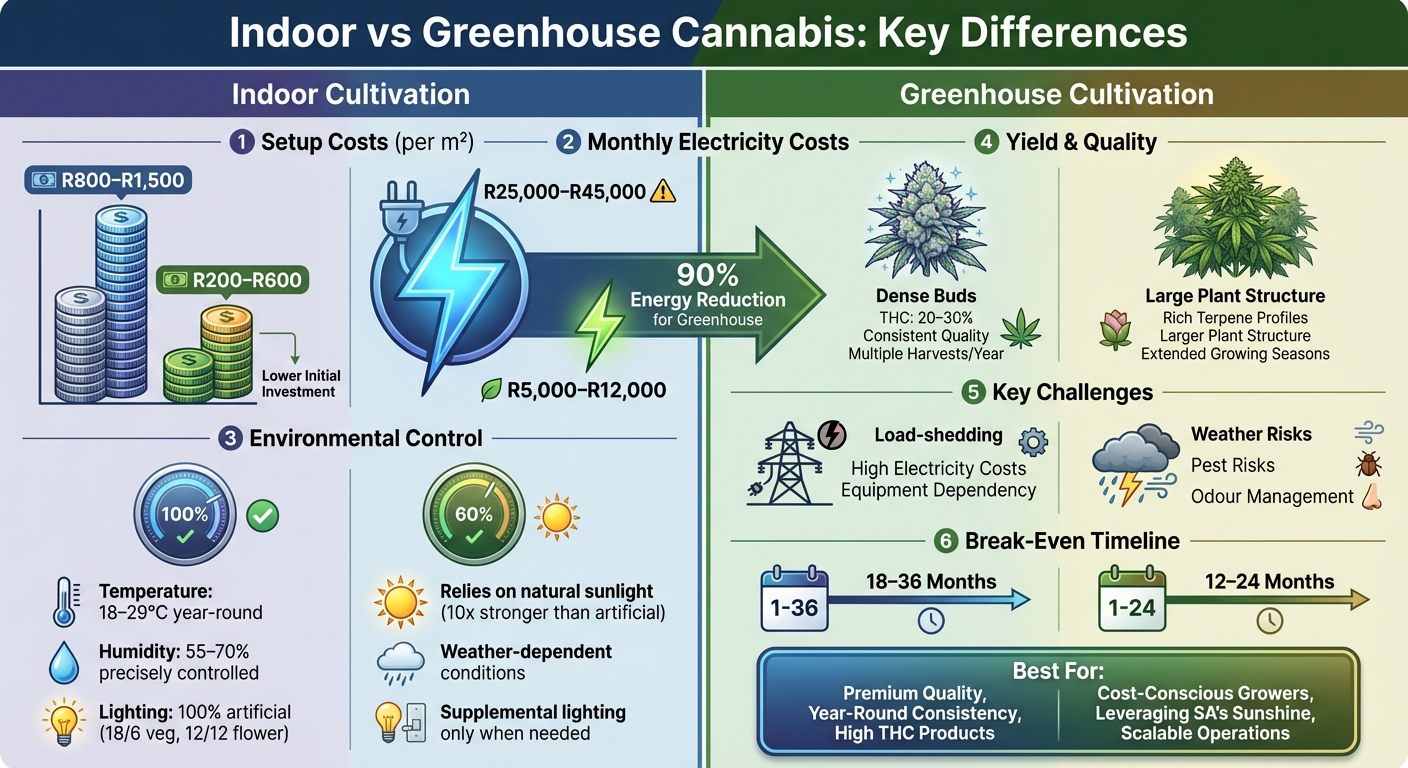
Indoor vs Greenhouse Cannabis Cultivation: Cost, Yield, and Control Comparison
Indoor vs Greenhouse Cannabis Growing
Indoor Cannabis Cultivation: How It Works
Indoor cannabis cultivation involves growing plants in controlled environments using artificial lighting and specialised equipment. These setups regulate every aspect of the plant's growth, including light cycles, temperature, humidity, airflow, CO₂ levels, and nutrient delivery systems.
One of the biggest advantages of indoor growing is its ability to maintain consistent conditions year-round, regardless of external weather. This not only supports uninterrupted production but also simplifies pest and disease control.
Indoor cultivation is particularly popular for producing high-quality cannabis with elevated potency, often reaching THC levels of 20–30%. It’s also ideal for newer cannabis genetics and hybrid strains that require stable environments. For growers in South Africa, indoor setups provide added benefits like enhanced security and privacy.
A typical indoor grow setup might include essentials like grow tents (a favourite among beginners), LED or HID lighting systems, ventilation fans equipped with carbon filters for odour control, environmental monitoring tools, and suitable growing media. The plants are usually grown on light cycles of 18 hours on/6 hours off during the vegetative stage, and 12 hours on/12 hours off during flowering. Temperatures are kept between 18–29°C, with humidity levels adjusted according to the growth stage. This level of precision is what makes indoor cultivation so effective, as outlined in the benefits below.
Benefits of Indoor Growing
The ability to control every environmental factor is a game-changer for growers. It allows for the production of premium-quality cannabis, optimised for both potency and flavour. The controlled environment also makes it easier to manage pests and diseases, while offering a secure and discreet growing option - an essential feature for many South African cultivators.
Indoor setups are particularly suited to cultivating cannabis genetics that may not perform well outdoors. By providing ideal conditions, growers can maximise their investment in both time and space, achieving consistently high-quality results.
Drawbacks of Indoor Growing
While the benefits are impressive, indoor cultivation does come with its share of challenges.
One major issue is the cost of electricity. Indoor growing requires constant lighting, ventilation, and climate control, which can lead to steep energy bills. In the United States, legal indoor cannabis operations account for 1% of the country’s total electricity use, costing an estimated US$6 billion annually. In South Africa, this challenge is compounded by regular load-shedding, often requiring growers to invest in backup power solutions like generators or inverters.
The initial setup costs can also be daunting. High-quality grow tents, lighting systems, ventilation equipment, and environmental controls can cost thousands of rands, with commercial installations being even pricier. Additionally, indoor cultivation depends heavily on equipment, meaning any failure - whether it’s a broken light, a malfunctioning fan, or a climate control issue - can jeopardise an entire crop.
Space is another limitation. Indoor setups are confined to the available building space, making it harder to scale operations compared to greenhouse growing. Maintenance is also an ongoing task, requiring close monitoring of systems, regular replacement of components like bulbs and filters, and quick resolution of any technical problems to maintain optimal growing conditions.
Greenhouse Cannabis Cultivation: How It Works
Greenhouse cannabis cultivation blends natural sunlight with controlled growing conditions, creating a middle ground between outdoor and indoor methods. Unlike indoor setups that depend entirely on artificial lighting, greenhouses primarily utilise sunlight, with artificial lighting added only when necessary.
Casey Rivero, Cannabis Solutions Architect at Fluence Bioengineering, sums up the difference:
"In an indoor facility, we are manufacturing the environment. In a greenhouse, we are controlling what the natural environment is doing and changing throughout the year".
This approach embraces nature while leveraging technology, offering unique opportunities and challenges compared to strictly indoor systems.
Greenhouses often use automated climate control systems that combine HVAC, supplemental HPS or LED lighting, shading, irrigation, and ventilation. These systems optimise natural sunlight, which is up to 10 times stronger than artificial lighting. Additionally, the full spectrum of natural light, including UV radiation, can boost the production of cannabinoids and terpenes in cannabis plants.
To manage light cycles, growers deploy light deprivation systems and blackout curtains to mimic natural photoperiods, encouraging flowering. They also supplement sunlight during shorter winter days or cloudy weather. This technology allows for year-round cultivation, extending the growing season.
In the United States, around 41% of cannabis growers use greenhouse systems, and this trend is becoming more common in South Africa. The appeal lies in better protection against weather and pests, making it a practical choice for local conditions.
Benefits of Greenhouse Growing
One major advantage of greenhouse cultivation is its lower energy costs. By relying on sunlight, greenhouses minimise electricity expenses - a significant saving in South Africa, where load-shedding and high electricity rates make indoor growing costly.
Greenhouses are also highly scalable. Unlike indoor facilities limited by physical building space, greenhouses can expand across available land more easily. This makes them ideal for commercial growers aiming to scale up production without the hefty infrastructure costs associated with indoor expansions.
Another benefit is the natural growing environment. The full spectrum of sunlight supports healthy plant growth and can yield cannabis with THC and terpene levels comparable to indoor-grown products, while avoiding the need for complex light spectrum management.
Drawbacks of Greenhouse Growing
Despite these advantages, greenhouse cultivation comes with its own set of challenges. Weather variability is a significant concern. While greenhouses offer partial climate control, they are still influenced by external conditions. South Africa's hot summers and unexpected cold spells can strain climate systems, making it difficult to maintain stable temperatures and humidity.
Pests and diseases also pose a greater risk. Since greenhouses are more exposed to outside air, they are more vulnerable to infestations and pathogens. This requires growers to implement rigorous pest management strategies and maintain constant vigilance.
Infrastructure demands can be complex as well. Greenhouses need systems that adapt to changing seasons, and growers must carefully balance external and internal conditions. For instance, supplemental red light must be managed cautiously to avoid photobleaching when combined with intense natural sunlight.
Lastly, odour control can be more challenging in greenhouses. Because they rely on outdoor air circulation, achieving the same level of odour mitigation as sealed indoor facilities often requires more robust systems.
Environmental Control: Indoor vs Greenhouse
This section expands on the earlier discussion about the pros and cons of indoor and greenhouse cultivation systems. Indoor cultivation operates within a completely controlled environment, while greenhouse systems work alongside natural conditions, adjusting to seasonal changes throughout the year. Indoor growers rely on HVAC systems, dehumidifiers, and carefully scheduled LED or HPS lighting to maintain consistent conditions year-round. However, the energy demands are substantial, particularly in South Africa, where load shedding intensifies the challenge. Lighting alone can account for 30–40% of the total energy usage.
Greenhouse cultivation, on the other hand, takes advantage of natural sunlight, which is about 10 times stronger than artificial lighting. Artificial lighting is used sparingly, only when necessary. Greenhouses also adapt to environmental changes by using shade cloths during hot weather, ventilation to regulate temperature, and heating during colder periods. While this method is more environmentally considerate, it is less precise due to the influence of outdoor weather patterns. These dynamics are especially relevant when considering South Africa's climate, which poses unique challenges for both systems.
Indoor setups must also address the heat generated by artificial lighting, which can raise cooling demands. Managing humidity is equally vital - levels above 70% can encourage bacteria and mould growth, while very low humidity can cause plant dehydration. Cannabis plants grow best in humidity levels between 55% and 70%, necessitating constant monitoring in both indoor and greenhouse environments.
Below is a comparison table highlighting the key differences in environmental control between indoor and greenhouse cultivation, with specific emphasis on South African conditions.
Table: Environmental Control Comparison
| Factor | Indoor Cultivation | Greenhouse Cultivation | South African Considerations |
|---|---|---|---|
| Temperature Control | Fully managed via HVAC systems; maintained at 18–28°C year-round | Partially controlled with ventilation, shade cloths, and heating; influenced by external conditions | Load shedding and high outdoor temperatures increase cooling needs |
| Humidity Management | Precisely regulated to stay between 55–70% | Requires constant monitoring; natural fluctuations may need dehumidification | High humidity during rainy seasons increases mould risks |
| Light Control | 100% artificial lighting for strict control over spectrum and photoperiod | Relies mostly on natural sunlight, with occasional artificial lighting | Using natural sunlight reduces energy usage |
| Air Circulation | Controlled airflow with filtration; breaches can spread issues | Semi-open ventilation, often aided by fans; proactive pest control needed | Open systems risk exposure to external contaminants |
| Consistency | Offers stable conditions regardless of season | Influenced by seasonal and weather variations | Unpredictable weather adds complexity to greenhouse operations |
Cost Analysis: Setup and Running Expenses
Let’s break down the financial aspects of different cultivation methods. Indoor cultivation demands a hefty upfront investment due to the need for artificial lighting, HVAC systems, dehumidifiers, and advanced filtration systems.
On the other hand, greenhouse farming provides a more affordable starting point for many growers. In South Africa, tunnel greenhouses range from R200–R300 per m², while multispan greenhouses cost between R300–R600 per m², depending on the level of automation and ventilation. Since greenhouses utilise natural sunlight, they significantly cut down on lighting costs.
The running costs for indoor facilities are notably higher, largely because of the energy demands for artificial lighting and climate control. Greenhouses, in contrast, can reduce energy expenses by as much as 90%. For example, electricity costs for indoor cannabis cultivation can reach up to $750 per pound, whereas greenhouse operations average around $350 per pound.
"Greenhouses have lower energy demands and costs compared to indoor cultivation, but are only efficient when following good agricultural and collection practices (GACPs) and using a facility and systems suited for professional cannabis production." - Bosman Van Zaal
When considering return on investment (ROI), it’s essential to think long-term. While greenhouses require an initial investment, their lower operational costs mean growers can break even faster. This makes greenhouses an appealing choice for those with limited funds, as they can start with a basic setup and expand over time. These cost differences are key to understanding the financial dynamics of each method.
Table: Cost Comparison in ZAR
| Cost Category | Indoor Cultivation | Greenhouse Cultivation | Notes |
|---|---|---|---|
| Initial Setup (per m²) | R800–R1,500+ | R200–R600 | Indoor setups require advanced lighting and HVAC. |
| Lighting Infrastructure | R300,000–R600,000+ (for 100m²) | R50,000–R150,000 (supplemental only) | Greenhouses mainly rely on natural sunlight. |
| Climate Control Systems | R200,000–R400,000 | R80,000–R200,000 | Indoor setups need complex HVAC systems. |
| Monthly Electricity (100m²) | R25,000–R45,000 | R5,000–R12,000 | Indoor costs are driven by lighting and cooling. |
| Water & Irrigation | R3,000–R6,000 | R2,500–R5,000 | Greenhouses may include rainwater harvesting. |
| Maintenance (annual) | R80,000–R150,000 | R40,000–R80,000 | Indoor equipment requires more frequent servicing. |
| Break-even Timeline | 18–36 months | 12–24 months | Lower operational costs speed up greenhouse ROI. |
This comparison highlights the stark differences in costs between indoor and greenhouse cultivation, helping growers decide which method aligns best with their budget and long-term goals.
sbb-itb-e2e45ce
Yield and Quality: What to Expect
Indoor and greenhouse cultivation methods lead to distinct harvest outcomes, each with its own advantages. Indoor growing provides precise environmental control, allowing for enhanced THC levels through CO₂ adjustments, although the plants themselves tend to be smaller.
Greenhouse cultivation, on the other hand, takes advantage of natural sunlight, which is far more powerful than artificial lighting. This full-spectrum light promotes richer cannabinoid and terpene profiles, giving greenhouse-grown cannabis a distinctive edge. By using light deprivation systems to control flowering times, greenhouse growers can extend growing seasons and boost yields. These differences in yield and quality often shape market strategies and production approaches.
In South Africa, choosing the right strain is critical. Indica strains are known for their high yields, while Sativa strains thrive in the local climate but typically produce less. Many growers opt for Indica/Sativa hybrids to strike a balance between yield and quality. This decision directly impacts both the quantity and the cannabinoid profile of the harvest.
"Indoor grows have a major advantage - no cloudy days, no rain, no excessive wind, and guaranteed light hours every day. This level of consistency allows indoor growers to create ideal conditions, especially for strains that demand precision, often resulting in buds with extremely high THC content."
– Mike Wilson, Cannabis Cultivator, Blimburn Seeds
Indoor setups allow for multiple harvests throughout the year, with consistent weekly batches. Greenhouse operations, while influenced by seasonal weather and humidity, can still achieve nearly continuous production through automation. Larger monthly harvests are typical for greenhouses, making them a viable option for high-volume production.
Here’s a quick comparison of the two methods:
Table: Yield and Quality Comparison
| Factor | Indoor Cultivation | Greenhouse Cultivation | South African Context |
|---|---|---|---|
| Harvest Frequency | Multiple annual harvests with weekly batches | Larger monthly harvests over extended seasons | Year-round production possible with both methods |
| Product Consistency | Very high due to controlled conditions | Moderate to high; natural fluctuations occur | Indoor suited for premium markets; greenhouse for volume |
| Cannabinoid Profiles | Higher THC potential via CO₂ manipulation | Broader profiles from natural sunlight | Dependent on strain genetics |
| Terpene Development | Consistent under artificial lighting | More complex under full-spectrum sunlight | Greenhouse thrives in coastal areas (e.g., Durban, Cape Town) |
| Bud Density | Denser buds | Larger overall structure | Indoor preferred for concentrates |
| Environmental Risks | Minimal due to full control | Moderate; weather and humidity factors | Gauteng’s dry climate suits greenhouses; coastal areas need careful monitoring |
| Strain Performance | Most strains perform reliably | Indica hybrids recommended for consistency | Sativas yield less; Indicas maximise output |
Pros and Cons: Side-by-Side Comparison
When choosing between indoor and greenhouse cannabis cultivation, it’s all about weighing the trade-offs. Indoor growing gives you complete control over the environment and ensures consistent production throughout the year. However, it comes with hefty upfront costs and high electricity bills - a challenge made even tougher by South Africa's frequent load-shedding. On the other hand, greenhouse cultivation leans on natural sunlight to keep energy costs down, while still offering protection against harsh weather and pests.
Indoor systems often produce cannabis with higher THC levels thanks to precise environmental controls. Meanwhile, greenhouses, with their reliance on the full spectrum of natural light, tend to enhance terpene profiles. Strain selection also plays a big role, especially in South Africa. For example, landrace strains like Durban Poison thrive in greenhouses, where they benefit from abundant sunlight and natural airflow. These factors highlight the unique advantages and challenges of each method in the local context.
"Greendoor systems have been gaining a lot of traction in South Africa over the last couple of years."
– Hey Bud SA
Here’s a quick comparison of the pros and cons of each approach:
Table: Indoor vs Greenhouse Pros and Cons
| Aspect | Indoor Cultivation | Greenhouse Cultivation |
|---|---|---|
| Advantages | Full environmental control, consistent year-round production, high-quality output, minimal pest risks, and potential for higher THC levels. | Lower energy costs, natural sunlight benefits, reduced carbon footprint, weather protection, and a more sustainable approach. |
| Disadvantages | Expensive electricity bills, reliance on backup power during load-shedding, high initial investment, and energy-intensive systems. | Less precise control over conditions, partial reliance on weather, humidity challenges, and seasonal fluctuations. |
| South African Context | Requires backup power solutions due to load-shedding, making it costlier but ideal for premium markets. | Cost-effective for small to medium growers, gaining popularity with "Greendoor" systems, and well-suited to strains like Durban Poison. |
| Regulatory Compliance | Can meet SAHPRA guidelines with proper setup and management. | Can meet SAHPRA guidelines with proper setup and management. |
| Long-term Viability | Higher carbon footprint and resource-heavy. | More environmentally friendly with reduced resource demands. |
South African Climate and Legal Requirements
South Africa’s diverse climate - ranging from dry interiors to milder coastal areas - plays a key role in how cannabis is cultivated, with growers often choosing between indoor and greenhouse setups. The country’s plentiful sunshine is a major advantage for greenhouse operations, reducing reliance on artificial lighting and cutting energy costs. However, this same intense sunlight can increase THC levels in cannabis plants, which can be problematic for growers working with industrial hemp that must adhere to strict THC limits. Greenhouses are well-suited for strains that thrive under natural light, while indoor systems provide the control needed to manage THC levels precisely. These climatic factors influence growers’ decisions and operational strategies.
Water scarcity is another pressing concern. Agriculture already consumes 66% of South Africa’s water resources, and cannabis is particularly water-intensive. On top of this, unpredictable weather patterns and load-shedding make energy efficiency a priority. Many growers are turning to technologies like LED lighting to reduce energy consumption in both indoor and greenhouse environments.
Legal regulations also play a significant role in shaping cultivation practices. The Cannabis for Private Purposes Act (CfPPA), enacted on 28 May 2024, clarified the rules surrounding personal cannabis use and cultivation. Adults aged 18 and older are now allowed to grow and use cannabis privately. This act removed cannabis from the Drugs and Drug Trafficking Act but strictly forbids any commercial use or dealing without proper authorisation. For personal growers, this means they can choose between indoor or greenhouse cultivation based on their resources and space, without needing to navigate heavy regulatory requirements.
For commercial growers, however, the landscape is far more complex. Since cannabis was decriminalised in 2019, over 100 medical cannabis licences have been issued in South Africa. Commercial operations, particularly those targeting the medical export market, must ensure consistent quality and higher yields to remain competitive. This often involves significant investment in compliance measures and operational design, whether they opt for indoor cultivation or greenhouses. Adhering to these strict regulations can drive up costs but is essential for maintaining market access.
How to Choose the Right Method
Start by looking at your budget. Indoor setups can be costly upfront, with expenses for lighting, HVAC systems, and dehumidifiers, not to mention the ongoing electricity bills. If you're working with limited funds, greenhouse cultivation might be a better option. It has lower operational costs, making it a more affordable starting point.
Next, think about your local climate and natural resources. South Africa's plentiful sunshine makes greenhouses an appealing choice, as natural sunlight is up to 10 times stronger than artificial lighting. However, if you're dealing with unpredictable weather or extreme temperatures, indoor cultivation might be the way to go. Indoor systems give you complete control over the growing environment, though they rely heavily on artificial lighting and HVAC systems. Greenhouses, on the other hand, make use of natural light and passive ventilation, cutting down on electricity usage [8,9]. Striking a balance between controlled conditions and natural elements is crucial for keeping costs low while maintaining good crop performance.
Your yield and quality goals are another key factor. Indoor cultivation allows for precise control over conditions, often resulting in higher THC levels. Meanwhile, greenhouse setups, which utilise natural sunlight - including UV-A and UV-B rays - can enhance the plant's cannabinoid and terpene profiles [8,9]. For example, strains like Durban Poison, a well-known South African landrace, thrive in greenhouses where abundant sunlight and airflow bring out their unique qualities.
Legal requirements and the scale of your operation also play a role in determining the best approach. If you're a personal grower under the Cannabis for Private Purposes Act, your choice will depend on the space and resources you have available. On the other hand, commercial growers targeting the medical export market often need consistent quality and larger yields. These demands can justify investing in controlled indoor facilities or hybrid greenhouse systems with supplemental lighting. Both methods, when managed correctly, can meet SAHPRA's standards for medicinal cannabis.
Conclusion
When it comes to balancing environmental control, costs, and yield, the best cultivation method will always depend on your specific situation. As Fluence Bioengineering wisely notes:
"There's no single 'best' method; the ideal choice is always context-dependent."
Indoor cultivation provides full control over the environment, ensuring consistently high-quality buds with elevated THC levels. However, this comes with the trade-off of higher electricity bills, as outlined earlier. On the other hand, greenhouses take advantage of South Africa's plentiful sunlight, offering a more energy-efficient approach and encouraging a rich terpene profile, though with slightly less control over growing conditions.
Ultimately, your choice will depend on factors like your budget, the local climate, your quality standards, and the scale of your operation. If you're working with a tighter budget and have access to South Africa's sunny conditions, greenhouse cultivation can be an economical way to get started. But if you're aiming for year-round consistency and top-tier potency for a premium market, the higher costs of indoor growing might be worth it. Both methods, when managed effectively, can yield outstanding results.
FAQs
What are the cost differences between growing cannabis indoors and in a greenhouse in South Africa?
The cost of cultivating cannabis in a greenhouse in South Africa generally falls between R300 and R600 per square metre. This variation depends on factors like the type of greenhouse structure and the level of automation involved. On the other hand, indoor cultivation is notably pricier due to its reliance on energy-intensive systems like specialised lighting and climate control.
Greenhouses have the advantage of harnessing natural sunlight, which helps cut down on energy expenses. However, indoor setups offer precise control over the growing environment, albeit at a much higher operational cost. Deciding which approach to take will largely hinge on your budget, objectives, and the resources available in your region.
How does South Africa’s climate affect the choice between indoor and greenhouse cannabis cultivation?
South Africa’s sunny weather, boasting an average solar radiation of 220 W/m² annually, creates excellent conditions for outdoor and greenhouse cannabis cultivation. The plentiful sunlight not only encourages natural plant growth but also cuts down on electricity expenses while boosting yields. Plus, the typically dry climate plays a big role in minimising the risk of mould - a common challenge for cannabis growers.
Greenhouses strike a balance between outdoor and indoor cultivation by blending natural sunlight with controlled conditions for temperature, humidity, and pest management. This approach is particularly beneficial for growing delicate strains or ensuring consistent results. Thanks to its favourable climate, especially in sunny, low-humidity areas, South Africa provides an ideal environment for efficient and cost-conscious cannabis farming.
How does energy consumption differ between indoor and greenhouse cannabis cultivation?
Indoor cannabis farming demands significantly more energy because it depends heavily on artificial lighting, climate control, and ventilation systems. This leads to steep electricity bills and a much larger carbon footprint - comparable to the energy needed to power thousands of homes each year.
Greenhouse cultivation offers a more energy-efficient alternative. By harnessing natural sunlight, it cuts energy use by roughly 60–75%. In South Africa, where sunlight is plentiful, this approach not only lowers costs but also reduces the strain on the environment.
0 comments