

If you're new to cannabis, the best way to ensure a safe and enjoyable experience is to start with a small dose and increase gradually. This approach helps you avoid unpleasant side effects like anxiety or nausea while finding the right amount for your body. Here's what you need to know:
- Start with 1–2.5 mg of THC for edibles or a single puff for smoking/vaping.
- Wait before increasing: Edibles can take up to 2 hours to kick in, so don’t rush.
- Track your experience: Keep a journal of doses, products, and effects.
- Choose quality products: Look for SAHPRA-compliant options with clear labelling.
This method works because everyone's body reacts differently to cannabis based on factors like weight, metabolism, and tolerance. By starting slow, you can build tolerance gradually, avoid overconsumption, and save money in the process.
For South African users, trusted brands like Amazol offer products with clear dosing to help you get started, such as AA Greenhouse pre-rolls for R70,00–R80,00. Whether you prefer smoking, oils, or edibles, always prioritise low doses and high-quality products for the best results.
Cannabis Dosing: How Much Should You Consume?
Why You Should Start Low and Go Slow
The "start low and go slow" approach is a trusted way to avoid unpleasant side effects while figuring out the right cannabis dose for your needs. This method is especially important for South African cannabis users. Here’s why it works.
Preventing Overconsumption
Taking too much cannabis, especially as a beginner, can lead to uncomfortable side effects. High doses may cause anxiety, paranoia, dizziness, nausea, or a racing heart. These reactions can be unsettling and last for hours.
Cannabis has what's called a biphasic effect. At lower doses, it can ease anxiety, but higher doses might actually make it worse. Katherine Golden, RN, Founder and CEO of Leaf411, highlights this:
"Starting low and moving up slowly will ensure you do not over consume for your body's tolerance or specific needs".
Edibles carry an even higher risk of overconsumption because they take longer to kick in - anywhere from 30 minutes to 2 hours. Many beginners mistakenly take more before the first dose has fully taken effect, leading to an overwhelming experience.
But avoiding overconsumption isn’t the only reason to go slow. It also helps with tolerance.
Building Tolerance Gradually
Taking smaller doses over time allows your body to adjust without overloading your cannabinoid receptors.
Frequent cannabis use often leads to tolerance, meaning you’ll need higher doses to feel the same effects. By starting with a low dose, you can identify the smallest amount that works for you before tolerance sets in. This not only improves your experience but also saves money by avoiding unnecessary overuse.
Finding Your Personal Dosage
Everyone’s ideal dose is different, influenced by factors like body weight, metabolism, and genetics. For instance, a dose that works for someone heavier might be too strong for someone lighter. This is why a gradual dosing approach is so effective.
Interestingly, research shows that for certain conditions like pain, lower doses may actually work better than higher ones. Dr. Ethan Budd Russo, a leading cannabis researcher, explains:
"Clinical research suggests that anything more than 30 mg a day is likely to increase the side effects of THC, and you probably won't feel any difference in terms of treating your symptoms".
What Affects Your Cannabis Dosage
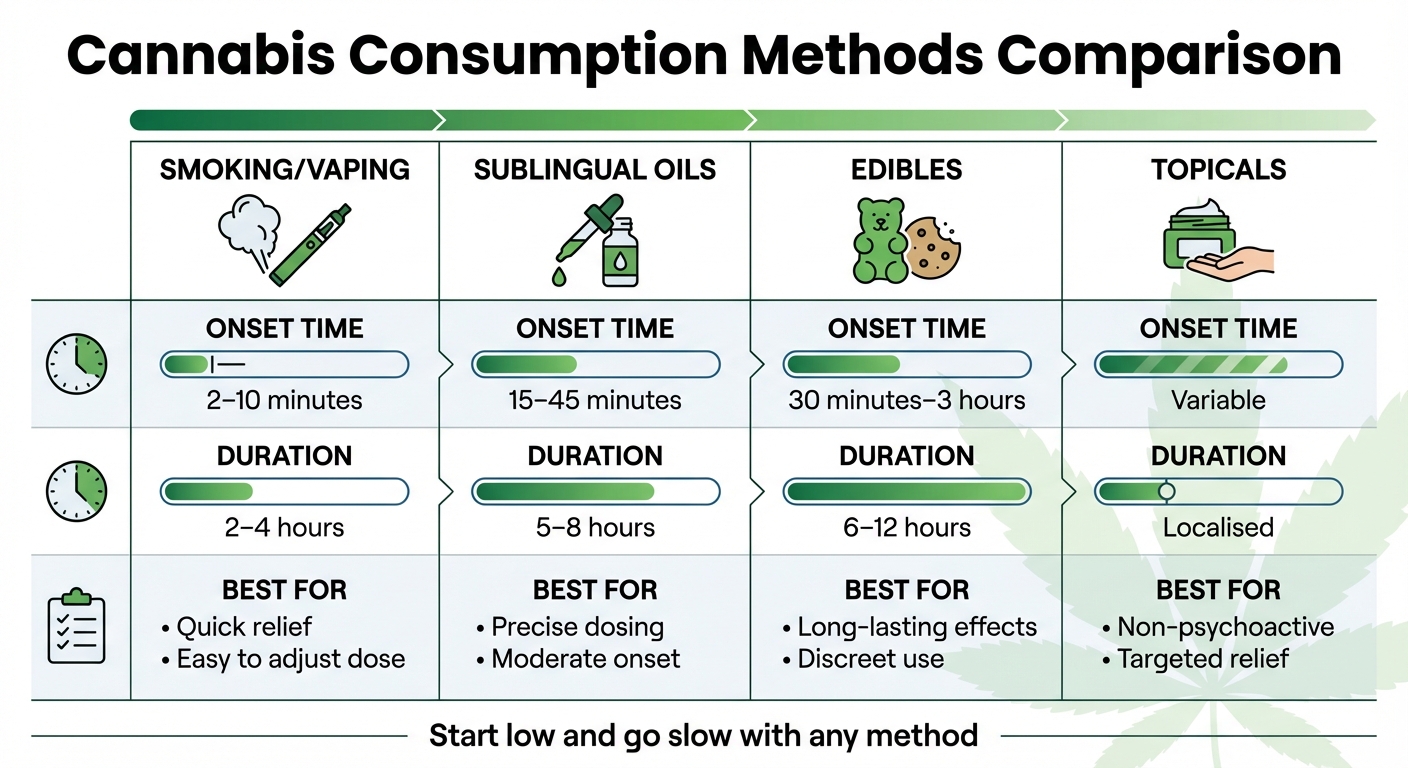
Cannabis Consumption Methods: Onset Time, Duration, and Best Uses Comparison
Your body's unique characteristics play a big role in how cannabis affects you. Knowing these factors can help you find a good starting point and adjust your dosage over time.
Body Weight and Metabolism
Your body weight influences how cannabinoids like THC and CBD are distributed in your system. Generally, individuals with higher body weight may need larger doses to feel the same effects as those who weigh less since the compounds become more diluted.
Metabolism is another key factor. If you have a fast metabolism, cannabis may take effect quicker but wear off sooner. On the other hand, a slower metabolism can lead to delayed onset but longer-lasting effects. Even at the same weight, people can respond differently due to variations in their endocannabinoid systems, which is why starting with small doses and gradually increasing is recommended.
For edibles, beginners under 45 kg are often advised to start with 1–2.5 mg of THC, while those over 113 kg might need 10–15 mg for a similar low-dose experience. However, these are just general guidelines - your personal reaction is the best measure.
Understanding your body weight and metabolism helps you choose the right consumption method and dosage.
Consumption Methods and How Long They Take to Work
How you consume cannabis affects how quickly you feel the effects and how long they last. Smoking or vaping provides almost instant results - typically within 2–10 minutes - making it easier to manage your dose one puff at a time. These effects usually last 2–4 hours.
Sublingual oils and tinctures take about 15–45 minutes to kick in, with effects lasting 5–8 hours. Edibles, however, take longer - anywhere from 30 minutes to 3 hours - but their effects can last 6–12 hours. This delayed onset often leads beginners to mistakenly consume more before the first dose has a chance to work.
Here’s a quick comparison of common methods:
| Method | Onset Time | Duration | Best For |
|---|---|---|---|
| Smoking/Vaping | 2–10 minutes | 2–4 hours | Quick relief; easy to adjust dose |
| Sublingual Oils | 15–45 minutes | 5–8 hours | Precise dosing; moderate onset |
| Edibles | 30 minutes–3 hours | 6–12 hours | Long-lasting effects; discreet use |
| Topicals | Variable | Localised | Non-psychoactive; targeted relief |
When you ingest cannabis, your liver converts THC into a stronger metabolite, which explains why edibles often feel more intense.
THC Strength and Choosing Products
The potency of the cannabis product is another critical factor in determining the right dose. Products with higher THC concentrations deliver stronger effects, even in small amounts, so beginners are better off starting with low-THC options.
Dr. Ethan Budd Russo, a respected cannabis researcher, suggests:
"The best practice for new patients would be to start at around 2.5 mg THC... this is enough to treat various symptoms for some people but might go unnoticed for others".
For South African users, brands like Amazol offer clearly labelled, tested products that make it easier to start low. For example, their AA Greenhouse pre-rolls, priced between R70,00 and R80,00, provide a milder experience compared to Premium Indoor options at R130,00. When choosing edibles, look for products with precise milligram labelling to ensure controlled dosing.
Products with a balanced THC-to-CBD ratio (1:1) are often gentler for beginners. CBD can help counteract some of THC's more overwhelming effects, such as anxiety. Research has also shown that full-spectrum CBD products can be effective at just 30 mg per day, compared to the much higher doses required for CBD isolates.
sbb-itb-e2e45ce
How to Find Your Right Dose: A Step-by-Step Guide
Finding the ideal cannabis dose takes patience, keen observation, and a careful process. Once you understand how your body and the product interact, follow these steps to zero in on what works best for you.
Step 1: Start with Low-THC Products
Begin with products that have lower THC levels, which are more suitable for beginners. For cannabis flower, go for options with 10% THC (100 mg/g) or less, and for edibles, stick to servings containing 2.5 mg of THC or less. Products with a 1:1 CBD-to-THC ratio are a good choice, as CBD can help balance out THC's stronger effects.
For example, Amazol's AA Greenhouse pre-rolls (priced between R70,00 and R80,00) are a gentler option compared to Premium Indoor products. When purchasing edibles or tinctures, always check the label to confirm the THC content per serving, not just the total amount. Edibles, in particular, require caution. As Katherine Golden, RN, Founder and CEO of Leaf411, notes:
"Colorado's suggested serving size for an edible is 10mg".
Steer clear of high-potency concentrates like hash, wax, or shatter, as these can be overwhelming for those new to cannabis.
Once you've chosen your product, it’s time to determine your starting dose.
Step 2: Begin with a Small Dose
The golden rule is to "start low and go slow". For edibles, begin with no more than 2.5 mg of THC. If you’re smoking or vaping, take just 1–2 small puffs. For oils or tinctures, use a few drops under your tongue.
While 5 mg of THC is often seen as a standard dose, beginners are better off starting with 1–2 mg to see how their body reacts.
Patience is key. With edibles, wait at least 2–3 hours before considering an additional dose, as the effects can take up to 4 hours to fully set in. For inhaled products, a waiting period of 15–30 minutes is recommended. Trying to rush the process can lead to overconsumption and unpleasant side effects.
Step 3: Monitor Effects and Adjust Gradually
Keep a record of your experiences in a cannabis journal. Include details like the product type, THC/CBD content, dose, method of consumption, time of use, and how it affected you. This habit can help you spot trends and fine-tune your dosage.
If your initial dose doesn’t yield the desired effects, don’t increase it on the same day. Instead, wait 24–48 hours before trying a slightly higher dose during your next session. When increasing, take small steps: add 2.5 mg of THC for edibles or one extra puff for flower every 2–3 days.
It’s worth noting that while lower doses can help with anxiety, higher doses might have the opposite effect. By documenting both the positive effects (like relaxation or pain relief) and any negative side effects (such as dizziness, rapid heartbeat, or paranoia), you’ll gain a clearer understanding of your limits.
How to Increase Your Dose Safely
Before making any adjustments to your dose, it's important to establish your baseline. Using a titration method can help you find the right amount that offers relief without causing unwanted side effects.
Microdosing and Moderate Use
If 2.5 mg provides only mild relief, consider increasing your dose gradually. For edibles, add 2.5 mg at a time; for inhalation methods, take an additional puff and wait 10–15 minutes to assess the effects. Many users find their ideal daily dose falls between 15–30 mg of THC. Dr. Ethan Budd Russo, a well-known cannabis researcher, explains:
"Somewhere between 15-30mg of THC is the desired total daily amount."
This range allows for moderate use while minimising the risk of side effects. Pay close attention to how your body reacts, and stop increasing your dose if you notice any negative effects.
Maximum Safe Doses
Research shows that consuming more than 30 mg of THC per day is unlikely to provide additional benefits and is more likely to cause side effects. Matan Weil from The Cannigma highlights this point:
"Exceeding 30 mg daily increases side effects without added benefit."
Avoid exceeding the 30 mg daily limit. If you’re not getting the relief you need, consult a healthcare professional for guidance. Additionally, limit the use of high-strength products to no more than once a week to reduce the likelihood of building a rapid tolerance.
Once you’ve become comfortable with your current dosage and product, you may want to explore other forms to refine your experience.
Trying Different Products
After finding a dose that works for you, consider experimenting with different products to see how alternative consumption methods affect you. For instance, if you started with pre-rolls, you might try edibles or tinctures. Keep in mind that even with the same THC content, different products can produce unique effects, so always start with a low dose when switching.
Look for products with clear labelling that specifies the exact milligrams of THC and CBD per serving. Products with a balanced 1:1 CBD-to-THC ratio can help reduce THC-induced anxiety and might allow you to handle slightly higher doses.
If you're new to cannabis, take extra care with high-concentration extracts like concentrates. Begin with lower-THC options to better understand your tolerance before trying stronger products.
Conclusion
A thoughtful and steady approach is key to having a safe and positive cannabis experience. Start slow, and keep track of how your body responds. As Katherine Golden, RN, Founder and CEO of Leaf411, wisely advises:
"Starting low and moving up slowly will ensure you do not over consume for your body's tolerance or specific needs".
This method helps minimise unpleasant effects like nausea or anxiety, giving you the chance to find your ideal therapeutic balance.
Keeping a record of your cannabis use - such as the product, dosage, method, and how it made you feel - can help you better manage its biphasic effects. Allow enough time between doses for your body to adjust properly.
It’s also important to choose high-quality products. Trusted platforms like Amazol make it easier to find clearly labelled options that suit your needs. Whether you’re starting out with AA Greenhouse pre-rolls for around R70,00 or exploring premium indoor flower and concentrates, they offer discreet delivery across South Africa.
FAQs
What’s the best way to track my cannabis dosage as a beginner?
To keep track of your cannabis dosage effectively, it’s best to start with a low dose and monitor how your body responds. Choosing products with clearly marked THC and CBD levels, like edibles or tinctures, can make it easier to measure your intake accurately.
Consider keeping a simple log where you jot down the amount consumed, the method (e.g., smoking, edibles, tinctures), and how you feel afterwards. Always wait at least two hours before increasing your dose - this gives your body enough time to process the effects and helps you avoid taking too much. With patience and consistency, this method can guide you in finding the ideal dosage for your needs.
If you’re ready to begin and need reliable cannabis products, check out Amazol. They offer a wide range, including premium flower, concentrates, and edibles, all delivered discreetly throughout South Africa.
What are the risks of using too much cannabis as a beginner?
Using too much cannabis, especially when you're new to it, can lead to uncomfortable side effects like anxiety, paranoia, dizziness, a racing heartbeat, or trouble with coordination. If you're not familiar with how cannabis interacts with your body, these sensations can feel overwhelming.
Edibles, in particular, require extra care. Their effects can take a while to kick in - sometimes up to 4 hours. This delay might tempt you to consume more, which increases the risk of overdoing it. To stay safe, it's best to start with a low dose - around 2.5 mg of THC or even less for edibles - and give it enough time to feel the effects before considering more.
By starting small and pacing yourself, you can reduce the risk of unpleasant experiences and enjoy cannabis more safely. Take the time to learn how your body responds, and you'll set yourself up for a better experience.
Does body weight affect how much cannabis I should use?
Yes, body weight can influence how much cannabis you might need, especially when it comes to edibles or other ingestible products. Generally, individuals with higher body weight may require slightly larger doses of THC to achieve the desired effects. On the other hand, those with lower body weight might need smaller amounts to avoid overconsumption or unpleasant side effects.
But body weight isn’t the only factor at play. Metabolism and tolerance are also key. For example, someone with a faster metabolism might feel the effects sooner, while regular cannabis users with higher tolerance levels may need larger doses to notice the same impact. The best way to figure out what works for you? Start low and go slow. Begin with a small dose and gradually increase it while paying close attention to how your body reacts. This method helps you find the right balance for a safe and enjoyable experience.
0 comments